https://prizmah.org/hayidion/ai-and-tech/ai-classroom
Connecting to Ancestors with AI
Michael Voskoboynik, Technology Coordinator, Hasten Hebrew Academy of Indianapolis
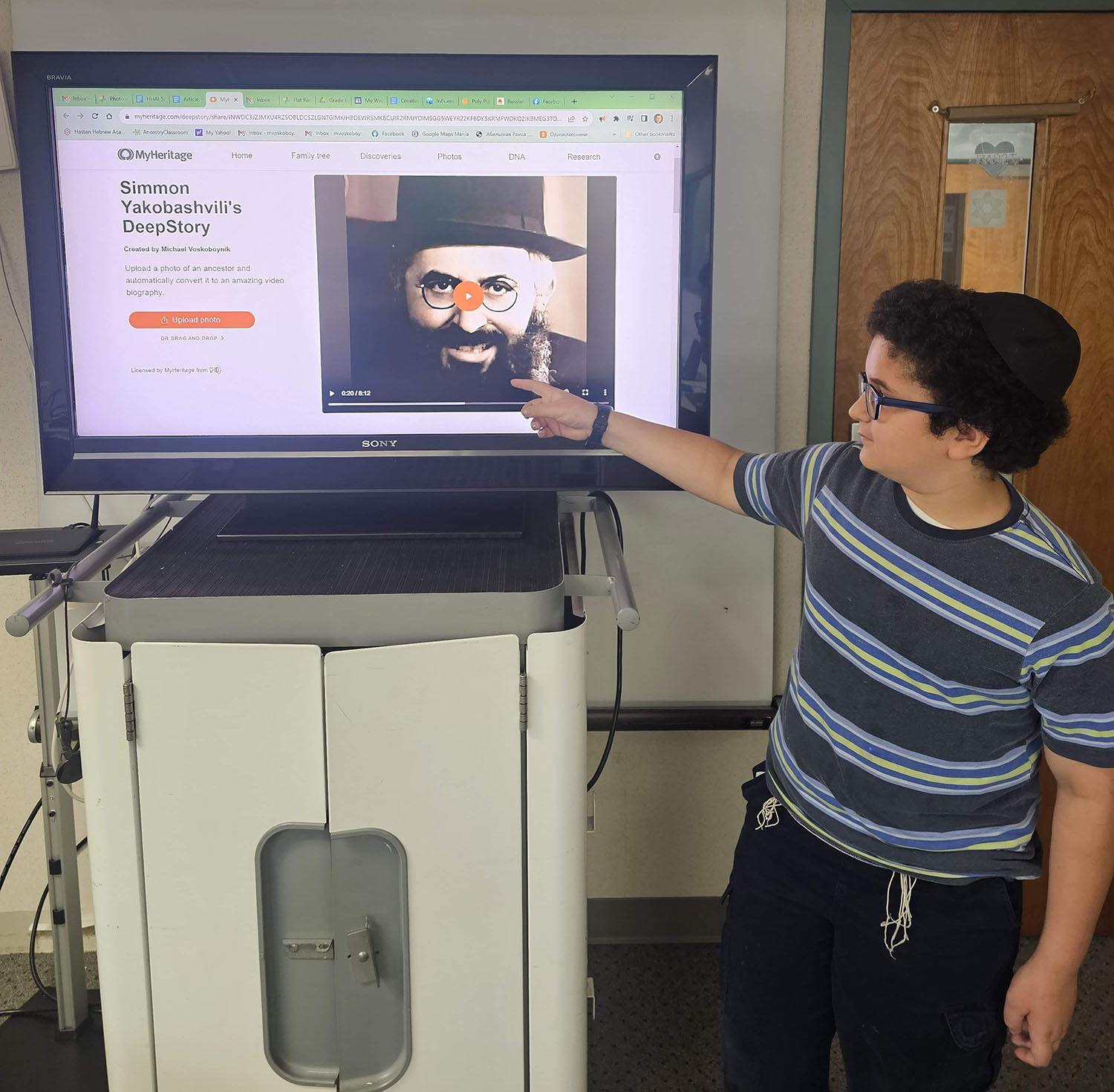
Our students regularly speak with their ancestors as well as long-gone heroes of Jewish history. At the Hasten Hebrew Academy, we embrace AI as a tool that connects students to their history while making humanities and Jewish history exciting.
For the past three years, our students and their families have worked collaboratively with Israeli peers in a program of the ANU – Museum of the Jewish People to bridge the gap between grandparents and their grandchildren. Students from both schools learn about their family origins by interviewing their family members and researching family artifacts.
An important part of this work is the use of the latest creative technology tools to make the final product interactive and engaging. Students created videos with Flip, traced their family origin with Google Earth, and depicted their family stories in VR with CoSpaces and Spatial.io. But when the “revolutionized” AI came along last year, they were able to add a cutting-edge dimension to this project.
Students found old family photos, often with parent and grandparent assistance, and used AI to enhance and colorize them and even add AI-generated backgrounds, making their great-grandparents feel more familiar and approachable.
These photos were then imported into MyHeritage AI Deep Story and Character AI, allowing students to speak to their ancestors! In order to make this work, students spoke with family members and researched to create detailed profiles of the individuals in the photos. This process helped strengthen generational family bonds as well as reinforcing the history the students are learning at school. Next, students needed to research the times during which their family members lived. This extensive information was then used to write scripts that their ancestors could access to answer modern-day questions. Students in essence brought their ancestors back to life, albeit virtually.
The AI tools helped students make this project a reality, but they also helped integrate knowledge and study skills from humanities, Judaic studies, music and so many other subjects. Students needed to use critical thinking to determine what information their ancestor would need to possess to be able to answer questions fully and seemingly independently. Presentation skills were of vital importance in the planning of the “interview” with their ancestor and then in explaining it to classmates, teachers, Israeli counterparts and attendees at the ISTE conference last summer.
This project provides students with meaningful connections with their families and those of their classmates and Israeli peers. While these presentations may take place over Zoom with the school in Israel, local parents join the students in their classroom, helping to explain family heirlooms and adding to what the students present. Their own family history is seen in light of everything they have learned in their other classes, and history becomes more personal and visceral.


